

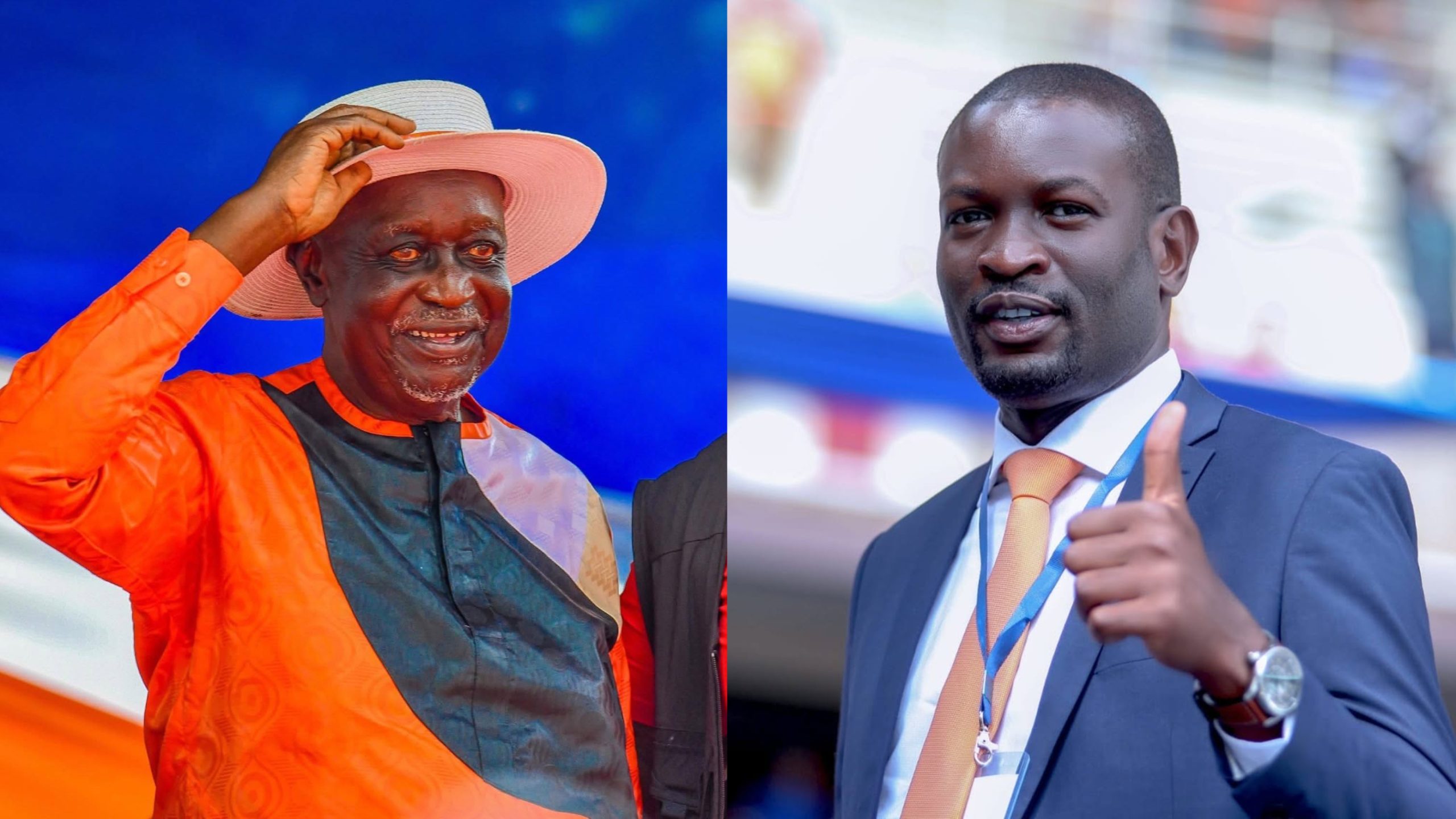
The political feud between former Orange Democratic Movement (ODM) Secretary-General Edwin Sifuna and party leader Oburu Oginga has taken on a new significance as ODM moves closer to a formal electoral partnership with President William Ruto ahead of the 2027 General Election.
ODM has now declared that it will not field its own presidential candidate in the next election and will instead support Ruto’s bid for a second term.
Party leader Oburu Oginga announced the position today in Naivasha during a joint Broad-Based Coalition Parliamentary Group meeting co-chaired with ODM leader Oburu Odinga and President Ruto, saying negotiations for a pre-election agreement with Ruto’s team had been completed.
The decision marks a major departure for a party that spent years campaigning against Ruto and whose late leader, Raila Odinga, built ODM into one of Kenya’s most formidable opposition movements.
It also helps explain why tensions between Oburu and Sifuna became increasingly difficult to contain.
A party divided over its political direction
The disagreement between the two leaders was never simply about personalities.
At its core was a fundamental question: Should ODM remain an independent opposition force, or should it join forces with Ruto and seek influence from within the next government?
Oburu has consistently argued that ODM must pursue strategic alliances if it wants to remain politically relevant and participate in the next administration.
ALSO READ: Sifuna Mocks Oburu Over Difficulty Reading Prepared Speech in Naivasha
In March, he said ODM’s objective was to be part of the government formed after the 2027 election and that this could be achieved through strategic coalitions. The party had already begun exploring a possible arrangement with Ruto’s United Democratic Alliance (UDA).
By July, that strategy had moved much closer to a definitive electoral pact.
Oburu said ODM had assessed the presidential contenders and decided to back Ruto rather than present its own candidate.
For Sifuna and other members of the dissenting faction, however, the decision represented a fundamental departure from the political identity ODM had built under Raila.
Sifuna’s resistance to the Ruto alliance
Sifuna had emerged as one of the strongest voices against ODM moving too close to the government.
During the earlier stages of the dispute, he and his allies pushed for ODM to maintain its independent political identity and prepare to compete in the 2027 presidential election.
That position put him directly at odds with Oburu’s strategy.
While Oburu argued that cooperation could enable ODM to influence government policy and secure development benefits for regions where the party enjoys strong support, Sifuna’s camp feared that ODM would lose its identity by becoming part of Ruto’s political machinery.
The disagreement became particularly sensitive because Sifuna was not an ordinary party member.
As Secretary-General, he was one of ODM’s principal public voices.
His opposition therefore had the potential to undermine the authority of the new party leadership.
Oburu’s authority versus Sifuna’s political influence
Oburu’s position was based on the decisions of ODM’s recognised organs.
His argument was that once the party had decided on a political strategy, senior officials were expected to respect that position.
Sifuna, however, increasingly acted as the face of a faction that disagreed with the direction being taken by the party leadership.
Oburu accused him of contradicting the party’s official position and participating in parallel political activities.
ALSO READ: Janelle Monae And Lupita Nyong’o Take Their Relationship Public!
The conflict eventually culminated in ODM removing Sifuna from the Secretary-General position.
The initial removal became the subject of a legal dispute after Sifuna challenged the process before the Political Parties Disputes Tribunal.
The tribunal later found that the initial disciplinary process had denied him a fair hearing, complicating the party’s first attempt to remove him.
ODM subsequently proceeded with another disciplinary process and ended his tenure as Secretary-General.
The “mediocrity” confrontation
The personal nature of the dispute became increasingly apparent when Sifuna publicly questioned Oburu’s leadership.
At a political gathering, Sifuna declared that he could not serve as Secretary-General under what he described as “mediocrity.”
The remark was interpreted as a direct attack on Oburu’s leadership and intensified the already bitter relationship between the two politicians.
Oburu subsequently said he could not work with a Secretary-General who publicly insulted him while remaining in the party’s leadership.
The confrontation exposed a deeper problem.
Sifuna had spent years serving under Raila Odinga and had become closely identified with Raila’s political project.
After Raila’s death, he did not appear willing to accept Oburu’s leadership without question.
Raila’s legacy at the centre of the dispute
The struggle is also about who controls Raila Odinga’s political legacy.
Oburu, as Raila’s elder brother and ODM’s current party leader, has sought to consolidate the party’s institutional structures after Raila’s death.
His supporters argue that ODM must adapt to a new political reality and make strategic alliances that can keep the party relevant.
Sifuna’s position has been markedly different.
His political arguments have frequently centred on preserving the opposition identity associated with Raila and ensuring that ODM does not abandon the political principles that made it a major opposition force.
The two sides therefore have different interpretations of what loyalty to Raila means.
For Oburu’s camp, it means protecting ODM as an organisation and ensuring that it remains powerful enough to influence government. Tunataka pawaaaa.
For Sifuna’s camp, it means protecting the political character and independence of the movement Raila built.
ODM’s alliance with Ruto changes everything
ODM’s decision to support Ruto in 2027 gives the internal dispute a much larger national dimension.
According to Oburu, the party’s decision is part of a negotiated coalition rather than unconditional political support.
The party has argued that cooperation with the government can help advance development and ensure that ODM has a role in the next administration. Oburu has also described the broad-based government arrangement as a strategic vehicle for maintaining ODM’s political influence.
The emerging arrangement means that ODM will enter the 2027 election as a partner of the incumbent rather than as a presidential challenger.
That is a dramatic transformation of the political landscape.
For Sifuna and those who opposed the alliance, however, it validates their fears that ODM is abandoning the opposition role it played for decades.
Why Sifuna’s opposition became a threat to Oburu
Sifuna’s resistance posed a particular problem for Oburu because it came from within the party’s own leadership.
A political rival outside ODM can be confronted through an election.
A senior official challenging the party’s strategy from within presents a different problem.
Sifuna had a national profile, a strong connection with ODM’s grassroots supporters and years of experience as the party’s chief public communicator.
His opposition could therefore not easily be dismissed as the views of an ordinary dissenting member.
For Oburu, maintaining party discipline became essential if ODM was going to negotiate with Ruto as a single political organisation.
For Sifuna, however, challenging the leadership was part of his effort to prevent what he regarded as the abandonment of ODM’s political identity.
A new political reality for Sifuna
With ODM now openly backing Ruto, Sifuna faces a new political reality.
The position he opposed has become the official direction of the party leadership.
This could deepen the divide between Sifuna and the Oburu-led ODM establishment, particularly if the coalition negotiations result in a formal pre-election agreement.
The question now is whether Sifuna will remain within ODM while opposing its national strategy or seek a new political platform ahead of 2027.
His future could also have implications for other ODM politicians who have resisted the Ruto alliance.
The bigger question: What remains of Raila’s ODM?
The dispute between Sifuna and Oburu ultimately raises a much bigger question about ODM after Raila Odinga.
For more than two decades, ODM’s political identity was closely tied to Raila’s opposition politics.
The party is now taking a fundamentally different path.
Under Oburu, ODM is positioning itself for a coalition with the incumbent president and has said it will support Ruto’s re-election rather than field its own presidential candidate. However, it should be noted that President Ruto is also a founder member of the ODM Party.
That transformation explains why the Sifuna–Oburu feud became so bitter.
Sifuna was not merely challenging an individual party leader.
He was challenging a political direction.
Oburu, meanwhile, was not merely defending his personal authority.
He was defending the strategy adopted by the party leadership.
The conflict between the two men therefore reflects a historic transition inside ODM — from Raila’s opposition movement to a party seeking power through a coalition with the very administration it once opposed.
As Kenya moves toward the 2027 General Election, the outcome of that transition could determine not only the future of Sifuna and Oburu, but also the identity and political relevance of ODM itself.