

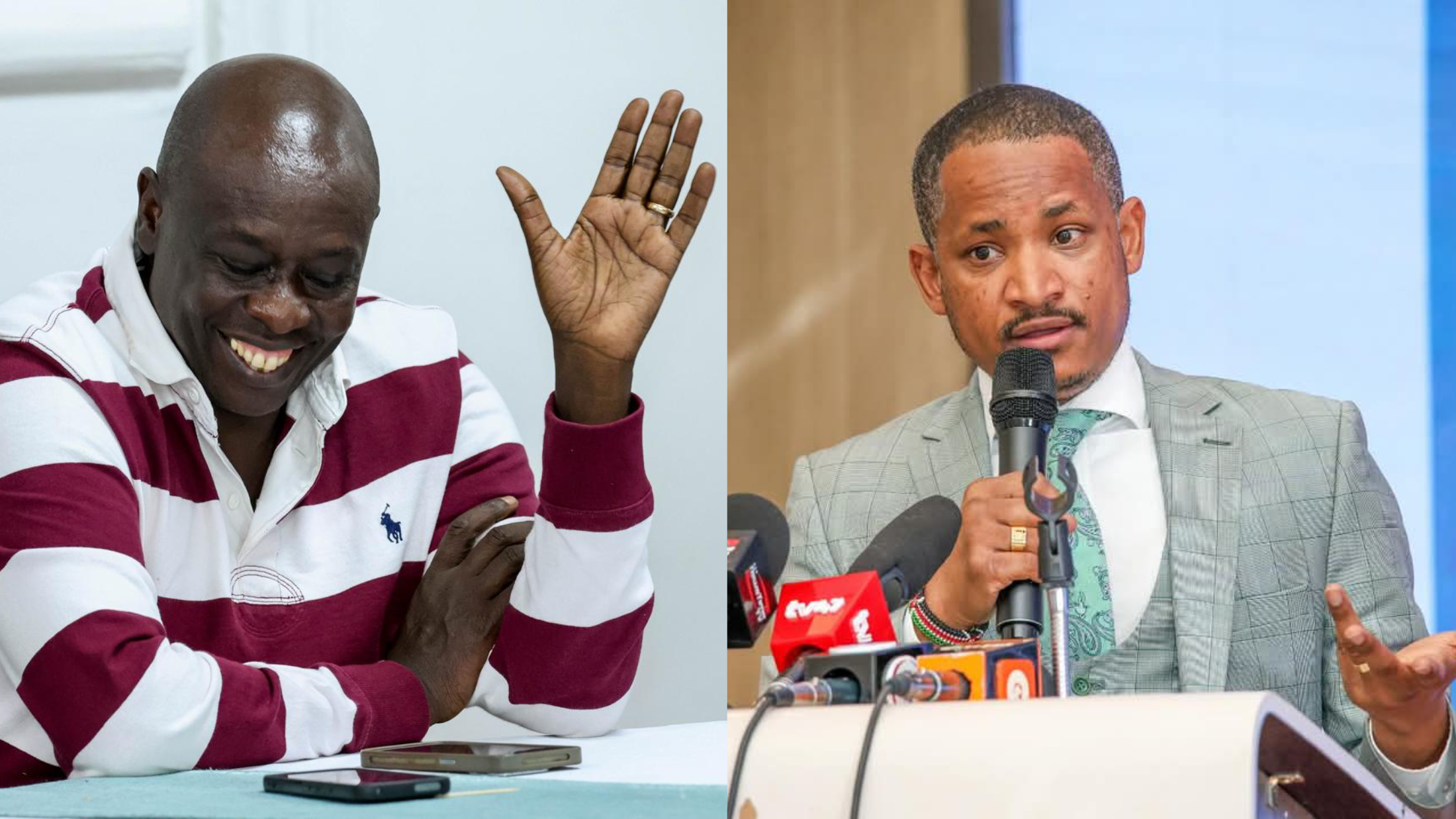
Former Deputy President Rigathi Gachagua’s planned tour of Luo Nyanza, reportedly at the invitation of Embakasi East MP Babu Owino, has been presented as a potentially significant moment in Kenya’s opposition politics.
Gachagua has publicly described Babu as his “buddy” and said he intends to visit Siaya, Migori, Homa Bay and Kisumu. On the surface, the move looks like an attempt by a politician whose political base has historically been concentrated in Mt Kenya to build relationships in a region long associated with Raila Odinga and the opposition.
But there is another way of reading it.
For many Luos, Gachagua’s sudden outreach raises an uncomfortable question: is this genuine political reconciliation, or is Nyanza once again being courted because its political support has become strategically useful?
That question cannot be separated from Murima’s own political record and rhetoric.
The politics of coming to Nyanza when you need Nyanza
Kenyan politics has a long history of politicians crossing regional and ethnic boundaries when they need to expand their political coalitions. There is nothing inherently wrong with that. Indeed, national politics requires leaders to seek support beyond their traditional strongholds.
The problem begins when political outreach is accompanied by a memory gap.
Gachagua spent much of his rise to national prominence championing Mt Kenya interests and speaking forcefully about what he described as the region’s political marginalisation. During his tenure as deputy president, his rhetoric frequently emphasised the numerical strength and political interests of the Kikuyu community.
His relationship with President William Ruto eventually collapsed, and Gachagua moved into opposition politics.
Now, the political arithmetic has changed.
The same Nyanza voters whose influence has sometimes been dismissed in conversations about Kenya’s electoral mathematics are once again being courted.
That is precisely why his planned visit deserves scrutiny.
If Nyanza’s votes were politically insignificant, why spend political capital seeking them?
The Luo question cannot be reduced to numbers
One of the more striking features of Kenyan politics is how quickly a community can be described as politically irrelevant when its support is not needed and strategically important when it is.
Gachagua has recently questioned the value of Luo votes in the context of the 2022 election and has repeatedly criticised the decision by President Ruto to build political bridges with the Luo community.
"Luos are my friends, I will tour Luo Nyanza soon!"~Gachagua shocks Wanga and Kaluma after his announcement pic.twitter.com/hlbNDwK85F
— Lightcast TV Kenya (@Lightcasttvke) August 24, 2026
Yet he is now preparing to enter Luo Nyanza with the help of one of the region’s most visible young political figures.
That contradiction should not simply be forgotten because the political circumstances have changed.
Political reconciliation is possible. Politicians can change their views. Communities can forgive and move forward.
But reconciliation requires honesty.
Gachagua cannot reasonably expect Nyanza to embrace his new political posture without asking what changed: his convictions, his circumstances, or simply the electoral arithmetic?
The historical memory matters
There is also a broader historical context that cannot be ignored.
Kenya’s political history contains repeated examples of alliances between leaders from different communities being formed when political circumstances demanded them, only for those relationships to change once power was secured.
The history of Jomo Kenyatta’s engagement with leaders and voters in Nyanza during the struggle for independence is one reminder that political alliances have often crossed ethnic boundaries when the objective required a broad national coalition.
But post-independence politics also created deep grievances among communities that once stood together against colonial rule.
That history has left many Luos particularly sensitive to political arrangements in which their support is sought during moments of political vulnerability but their interests are treated differently once power has been secured.
That is why Gachagua’s outreach should be judged by more than warm handshakes, political rallies or references to friendship.
Babu Owino’s role
Babu Owino is clearly becoming an important part of this political equation.
His emergence as one of the younger voices in the post-Raila opposition landscape gives him access to a constituency that Gachagua does not naturally command.
That makes Babu an attractive political bridge.
But it also raises a question for Babu himself.
Is he opening Nyanza to a genuine national coalition, or is he providing political cover for a politician seeking to rebuild his national fortunes?
There is nothing wrong with Babu talking to Gachagua. In fact, opposition politicians should be talking to one another if they hope to challenge the Kenya Kwanza establishment in 2027.
But dialogue is not endorsement.
And Babu’s willingness to host Gachagua should not automatically be interpreted as Nyanza giving Gachagua its political blessing.
Nyanza should not be anybody’s launchpad
This is perhaps the most important point.
Nyanza should not become the launchpad for another politician’s presidential ambitions simply because that politician has suddenly discovered the value of Luo voters.
If Gachagua genuinely wants to build a national political coalition, he should demonstrate it through sustained engagement, policy commitments and respect for the political agency of Nyanza voters.
He should be prepared to answer difficult questions about his previous rhetoric.
He should explain what he believes about regional political equality.
He should demonstrate that his relationship with Nyanza is not merely transactional.
And he should accept that voters have every right to remember what he said before they decide whether to believe what he says now.
The danger of political amnesia
The temptation in Kenyan politics is to treat every new alliance as a fresh beginning.
That encourages political amnesia.
A politician insults a community today, courts it tomorrow and expects yesterday to disappear.
A politician condemns another region’s political influence while in government and celebrates that region’s importance when seeking opposition support.
Then, when elections approach, everyone is encouraged to forget.
Nyanza does not have to participate in that cycle.
The lesson is not that Luos should reject Gachagua because he is Kikuyu, just as it would be wrong to support or reject any politician simply because of ethnicity.
The relevant question is what Gachagua stands for now and whether his political programme deserves support.
That is the standard that should apply to every politician, regardless of community.
2027 should not be about revenge
There is also a danger in interpreting the emerging political realignment purely through the lens of ethnic revenge.
Some voices are already suggesting that Nyanza should use the present political circumstances to punish Mt Kenya politically for past grievances.
That would simply reproduce the same ethnic logic that has damaged Kenyan politics for decades.
If Gachagua has indeed been hostile to Luo political interests in the past, the answer should not be to become hostile to Kikuyu interests in return.
The answer should be political accountability.
If a leader wants Luo votes, ask what he is offering.
If he wants Nyanza’s support, ask what his government would do differently.
If he claims to have changed, ask what caused the change.
And if he wants to build a national coalition, demand that the coalition be based on equal political citizenship rather than ethnic bargaining.
The real test begins when Gachagua arrives
Gachagua’s visit to Nyanza could therefore be important, but perhaps not for the reason his supporters imagine.
The question is not whether he can attract a crowd in Kisumu or Homa Bay.
The question is whether he can convince voters that this is something more than electoral arithmetic.
Will he engage leaders beyond his immediate political allies?
Will he acknowledge the grievances created by his previous rhetoric?
Will he offer a political programme that treats Nyanza as a partner rather than a voting bloc?
Will he continue visiting the region after the cameras leave?
Those are the tests that matter.
For Babu Owino, the challenge is equally significant. He can help build bridges across Kenya’s political divides, but he should be careful not to confuse access to Nyanza with ownership of its political choices.
A bridge, but no blank cheque
There is nothing inherently wrong with Gachagua seeking friendship with Babu Owino or travelling to Luo Nyanza.
Indeed, if Kenya is serious about overcoming its politics of ethnic exclusion, politicians from different communities should be able to build genuine relationships.
But reconciliation cannot mean political amnesia.
Gachagua should not receive a blank cheque simply because he has discovered that Nyanza matters.
And Nyanza should not reject him simply because he comes from Mt Kenya.
The proper response is neither blind embrace nor ethnic hostility.
It is scrutiny.
If Gachagua wants to build a bridge into Nyanza, let him build it.
But let that bridge be constructed on accountability, mutual respect and policy—not on the assumption that Luo voters will once again provide the missing numbers for another politician’s journey to State House.
Nyanza has political agency.
Its voters are not anybody’s “useful idiots,” bargaining chips or launchpad.
And if 2027 is going to produce a genuinely new political order, perhaps the first thing Kenya needs to abandon is the idea that one community must repeatedly be used by another before being discarded once power is secured.
The question facing Nyanza is therefore not whether Gachagua needs Luo votes.
Clearly, he does.
The more important question is whether he has given Nyanza a compelling reason to give them to him.